

Nicholas Roerich

Nicholas Roerich était un artiste, archéologue, auteur, érudit, conférencier, costumier et décorateur, poète, mystique et explorateur de renommée mondiale. Au début du XXe siècle, lui et son épouse, Helena Roerich, ont servi de secrétaires aux maîtres ascensionnés El Morya et Maitreya. Nicholas a ascensionné à la fin de cette vie.
Premières années
Il est né à Saint-Pétersbourg le 9 octobre 1874, fils aîné de Konstantin et Maria Roerich. Le prénom « Nicolas » signifie « celui qui vainc » et « Roerich » signifie « riche en gloire ». Son père était un avocat et notaire réputé, et Nicolas passa une grande partie de sa jeunesse dans le grand domaine familial d'Isvara, situé à environ 90 km au sud-ouest de Saint-Pétersbourg. C'est là, dans la beauté du nord de la Russie, que le jeune Nicolas développa un amour pour la nature qui dura toute sa vie. À Isvara, il se découvrit une passion pour la chasse et un vif intérêt pour l'histoire naturelle, l'archéologie et l'histoire de la Russie. Il aimait la musique et l'équitation.

Son père voulait qu'il fasse des études de droit, mais Nicolas souhaitait se consacrer à l'art. Nicolas résolut le problème en s'inscrivant simultanément à la faculté de droit de l'Université impériale et à l'Académie impériale des arts.
En 1898, Nicolas devient directeur adjoint du musée de la Société pour l'encouragement des arts. En septembre 1900, il se rend à Paris pour étudier l'art. À l'été 1901, Nicolas retourna à Saint-Pétersbourg et épousa Helena Ivanovna Shaposhnikova en octobre. Helena était une pianiste accomplie et fut considérée comme une éminente femme de lettres et une écrivaine prolifique dans la tradition ésotérique de la religion orientale. Elle était sa âme sœur, une source d'inspiration et un soutien pour Nicolas tout au long de sa vie. Nicolas et Helena eurent deux fils, George et Svetoslav.
Au début des années 1900, les Roerich ont beaucoup voyagé à travers la Russie et l'Europe. Au cours de ces voyages, le professeur Roerich a peint, entrepris des fouilles archéologiques, étudié l'architecture, donné des conférences et écrit sur l'art et l'archéologie. En 1906, il a été promu de secrétaire à directeur de l'école de la Société pour l'encouragement des arts.
En 1907, il commence à mettre son talent au service de la conception de décors et de costumes. Cette activité devient pour Roerich une carrière épanouissante et couronnée de succès. Il conçoit des décors et des costumes pour les productions de ballet et d'opéra de Diaghilev, notamment « Le Sacre du printemps » de Stravinsky, ainsi que pour la quasi-totalité des opéras de Wagner et de nombreux opéras de Rimski-Korsakov.
cLa famille Roerich quitta la Russie pour la Finlande en 1918, peu avant la fermeture définitive de la frontière entre la Finlande et l'Union soviétique. À l'invitation du directeur du Chicago Art Institute, Roerich arriva aux États-Unis en 1920. Il voyagea beaucoup, donna des conférences et exposa ses œuvres. Pendant son séjour aux États-Unis, Roerich fonda le Master Institute of United Arts, une société internationale d'artistes appelée Cor Ardens (qui signifie « cœur enflammé ») et un centre artistique international à New York appelé Corona Mundi (qui signifie « couronne du monde »). En hommage à Roerich, le musée Roerich fut créé à New York en 1923.

Œuvre d'art
De nombreuses œuvres de Roerich représentent de magnifiques scènes naturelles, et ses thèmes s'inspirent de l'histoire, de l'architecture et de la religion. Ses peintures sont mystiques, allégoriques et même prophétiques. Entre 1912 et 1914, ses peintures reflétaient souvent un sentiment de cataclysme imminent. L'une d'entre elles, Le dernier ange (1912), représente un violent incendie qui envahit une ville ; au-dessus de la ville, entouré de nuages de fumée tourbillonnants, un ange portant une épée et un bouclier annonce le Jugement dernier. En 1936, juste avant la Seconde Guerre mondiale, Roerich peint Armageddon. On peut voir les toits d'une ville à travers les nuages de fumée, avec les silhouettes de soldats marchant au premier plan, au bas du tableau.
Le style artistique de Roerich est difficile à décrire car, comme l'a dit Claude Bragdon, il appartient à une confrérie d'artistes d'élite — parmi lesquels Léonard de Vinci, Rembrandt, Blake et, en musique, Beethoven — dont les œuvres possèdent « une qualité unique, profonde et même mystique qui les différencie de celles de leurs contemporains, rendant impossible leur classement dans une catégorie connue ou leur rattachement à une école, car elles ne ressemblent qu'à elles-mêmes — et les unes aux autres, comme un ordre d'initiés atemporel et intemporel. »[1]
Voyage vers l'Orient
Nicholas Roerich a été fortement influencé par la culture orientale. Il souhaitait depuis longtemps voyager en Orient afin d'étudier la culture ancienne sur place, et en 1923, il s'embarqua pour l'Inde. Il résida quelque temps au Sikkim (alors un royaume limitrophe du nord-est de l'Inde) tout en finalisant les préparatifs d'une expédition en Asie centrale. Roerich écrivit à propos de son enchantement pour les montagnes :
Tous les enseignants ont voyagé dans les montagnes. La connaissance la plus élevée, les chants les plus inspirés, les sons et les couleurs les plus superbes sont créés dans les montagnes. Sur les plus hautes montagnes se trouve le Suprême. Les hautes montagnes sont les témoins de la grande réalité. [2]
Himalaya ! Voici la demeure des Rishis. Ici résonnait la flûte sacrée de Krishna. Ici tonnait le bienheureux Gautama Bouddha. Ici sont nés tous les Vedas. Ici vivaient les Pandavas. Ici, Gesar Khan. Ici, Aryavarta. Ici se trouve Shambhala. Himalaya, joyau de l'Inde. Himalaya, trésor du monde. Himalaya, symbole sacré de l'ascension. [3]
Nicholas et Helena Roerich partageaient tous deux un intérêt profond pour la philosophie et la religion orientales. Bon nombre de ses peintures représentent à la fois des divinités, des saints et des sages occidentaux et orientaux. Sa série « Bannières de l'Orient » dépeint non seulement les chefs spirituels du passé, mais aussi les espoirs de l'Orient pour un futur leader. Roerich a capturé ces espoirs dans ses peintures de Maitreya et de la Mère du Monde.
En 1925, Roerich entreprit son expédition en Asie centrale avec Helena, son fils George et plusieurs autres Européens. Roerich écrivit à propos de ses objectifs :
Of course, as an artist my main aspiration in Asia was towards artistic work.... In addition to its artistic aims, our Expedition planned to study the position of the ancient monuments of Central Asia, to observe the present condition of religions and creeds, and to note the traces of the great migrations of nations.[4]
Roerich’s party traveled 15,500 miles through Central Asia in an arduous and often dangerous trek that took more than four years. Despite overwhelming obstacles, Roerich executed hundreds of paintings during the journey.
While on this expedition, Roerich discovered legends and manuscripts recounting the journey Jesus took to the East during his so-called lost years between the ages of twelve and thirty. The same or similar manuscripts were also found by Russian journalist Nicolas Notovitch and Swami Abhedananda at Himis monastery in Ladakh.[5]
At the conclusion of the Central Asian expedition in 1928, the Roerichs permanently settled in the Kulu Valley in India. There they founded the Urusvati Himalayan Research Institute to study archaeology, linguistics and botany.

The Banner of Peace
One of the goals of Roerich’s lifelong pursuit of preserving the world’s cultural heritage came to fruition in 1935 with the signing of the Roerich Pact treaty at the White House by representatives of the countries comprising the Pan-American Union. Under the pact, nations at war were obliged to respect museums, universities, cathedrals and libraries as they did hospitals. Just as hospitals flew the Red Cross flag, cultural institutions would fly Roerich’s “Banner of Peace,” a flag that has a white field with three red spheres in the center surrounded by a red circle. Roerich believed that by protecting culture, the spiritual health of the nations would be preserved.
Roerich was nominated for the Nobel Peace Prize in 1929 and 1935 for his efforts to promote international peace through art and culture and to protect art treasures in time of war. World War II interrupted his activities and those of the Urusvati Himalayan Research Institute, and Roerich devoted himself to helping victims of the war. He also donated money from the sale of his paintings and books to the Soviet Red Cross.
In the summer of 1947, Roerich had heart surgery but was soon back at his easel. One of the last works Roerich painted is called The Master’s Command. It depicts a white eagle flying toward a devotee who is meditating in the lotus posture atop a high cliff overlooking a mountain valley. On December 13, 1947, while Roerich was working on a variant of this picture, his heart suddenly failed and his soul took flight to higher octaves. He was seventy-three years old.

Legacy
Throughout his life, Nicholas Roerich found the time to be involved in a multitude of activities and to do them all well. His spiritual life was the wellspring from which his literary and artistic vision arose. In an article about the character and work of his father, Svetoslav Roerich summed up the artist’s quest for inner spirituality:
He was a great patriot and he loved his Motherland, yet he belonged to the entire world and the whole world was his field of activity. Every race of men was to him a brotherly race, every country a place of special interest and of special significance. Every religion was a path to the Ultimate and to him life meant the great gates leading into the Future.... Every effort of his was directed towards the realisation of the Beautiful and his thoughts found a masterful embodiment in his paintings, writings and public life....
Through all his paintings and writings runs the continuous thread of a great message—the message of the Teacher calling to the disciples to awaken and strive towards a new life, a better life, a life of beauty and fulfillment.[6]
His service as an ascended master
The ascended master Nicholas Roerich says:
I am grateful to address you today, to speak to you from the plane of the ascended masters that you might know that one from among you has graduated to this level and that you might accomplish the same. Never tire, then, in the work that is your dharma, your duty to be the wholeness of yourself. Never be frustrated that you are misunderstood or before your time in your understanding of the stars, the universes, the mountains and the petals of a flower. I have indeed fought the good fight, and I have won.[7]
He asks us to call to him, and he stresses the use of the violet flame:
I ask you, chelas of the ascended masters, to include my name in your decrees and preambles, as I work closely with El Morya, K.H. and D.K., and Lanello. I work closely with them for the bringing together of all those who are on the path of the sacred fire.[8]
Gallery
-
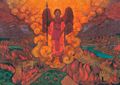
The Last Angel (1912)
-

And We Are Not Afraid (1922)
-

Mother of the World (1924)
-
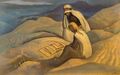
Padmasambhava (1924)
-

Mohammed on Mount Hira (1925)
-

Mohammed on Mount Hira (1925)
-

Milarepa, the One Who Harkened (1925)
-
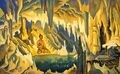
Buddha the Winner (1925)
-

Mohammed the Prophet (1925)
-
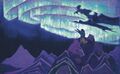
Moses the Leader (1926)
-
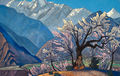
Krishna (Spring in Kulu) (1930)
-

St. Panteleimon the Healer (1931)
-
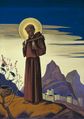
St. Francis (1932)
-

Tibet. Himalayas (1933)
-
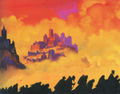
Armageddon (1936)
-

On the Heights (Tumo) (1936)
-

Star of the Hero (1936)
-
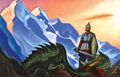
Victory (Gorynych the Serpent), Nicholas Roerich (1942)
-

Song of Shambhala (1943)


_1936.jpg)


For more information
For more information about Nicholas Roerich and his magnificent artwork, see the website of the Nicholas Roerich Museum, New York, www.roerich.org.
Sources
Mark L. Prophet and Elizabeth Clare Prophet, The Masters and Their Retreats, s.v. “Nicholas Roerich.”
- ↑ Claude Bragdon, Introduction, dans Nicholas Roerich, Altai-Himalaya : Journal de voyage » (Brookfield, Conn. : Arun Press, 1929), p. xix.
- ↑ Nicholas Roerich, « Himalayas: Abode of Light » (Bombay : Nalanda Publications, 1947), p. 21, dans Jacqueline Decter, « Nicholas Roerich: The Life and Art of a Russian Master (Rochester, Vt. : Park Street Press, 1989), p. 141.
- ↑ Nicholas Roerich, « Himalaya », p. 13, dans Decter, « Nicholas Roerich », p. 203.
- ↑ Nicholas Roerich, Heart of Asia (New York: Roerich Museum Press, 1929), pp. 7, 8.
- ↑ Roerich, Notovotch and Abhedananda all published their translations of these texts describing Jesus’ journey to the East. All three accounts are included in Elizabeth Clare Prophet, The Lost Years of Jesus: Documentary Evidence of Jesus’ 17-Year Journey to the East.
- ↑ Svetoslav Roerich, “My Father,” in Nicholas Roerich (New York: Nicholas Roerich Museum, 1974), p. 15.
- ↑ Nicholas Roerich, “Be the Unextinguishable Ones!” Pearls of Wisdom, vol. 33, no. 44, November 11, 1990.
- ↑ Ibid.